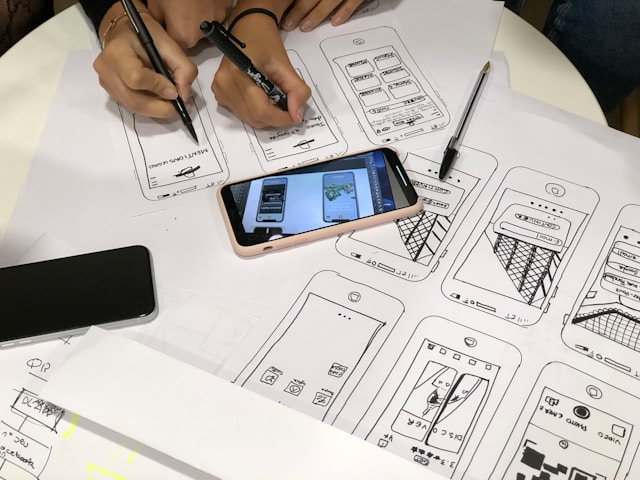
In the digital-first economy, your product’s interface is often the first and only point of contact between your brand and your potential customers. While user experience (UX) defines how a product works, the User Interface (UI) defines how it feels.
Within the first few milliseconds of landing on a page or opening an app, users make a subconscious judgment about the credibility and professionalism of the business. A cluttered, outdated, or inconsistent interface can drive users away before they even discover the value of your services.
The Psychology of Visual Hierarchy and Interaction
A great user interface is much more than a collection of beautiful buttons and icons. It is a carefully orchestrated system of visual hierarchy that guides the user’s eye toward the most important information.
By using contrast, whitespace, and typography strategically, designers can control the flow of a user’s journey, making complex tasks feel effortless. This is where the intersection of art and science becomes evident; understanding how the human brain processes visual patterns is essential for creating an interface that feels intuitive rather than overwhelming.
Color theory also plays a pivotal role in UI. Different colors evoke different emotional responses; blue can instill a sense of security and trust in financial applications, while vibrant oranges or greens might encourage action in fitness or e-commerce apps.

However, these choices must be balanced with accessibility standards. Ensuring sufficient color contrast is not just about aesthetics; it is about making sure that your product is usable by everyone, including those with visual impairments. When beauty and accessibility work in harmony, the result is a product that resonates with a wider audience.
Scalability Through Professional UI Systems
As digital products grow, maintaining visual consistency becomes a significant challenge. This is especially true for companies that have multiple teams working on different features simultaneously. Without a unified vision, the product can quickly become a “Frankenstein” of different styles and components.
To prevent this, many organizations turn to professional UI design services to help them build and implement comprehensive Design Systems. A Design System is a living library of reusable components and guidelines that ensures every new feature looks and feels like it belongs to the same family.
Working with an external partner to establish these standards provides an objective perspective that internal teams might lack. These specialists bring experience from various industries, allowing them to implement best practices for component libraries, iconography, and responsive grids.
This investment in a solid UI foundation pays off in the long run by significantly reducing development time. When developers have a library of pre-approved UI components to work with, they can focus on building functionality rather than debating the border radius of a button.

The Future of Digital Interfaces
We are moving toward an era where the interface is becoming more personalized and adaptive. Dark mode, high-contrast themes, and motion design are no longer optional extras; they are expected features.
UI design is also evolving to accommodate voice interfaces and augmented reality, requiring a more fluid approach to visual storytelling. By prioritizing high-quality UI design today, businesses are not just improving their current conversion rates; they are future-proofing their brand in a world where the quality of the digital experience is the ultimate competitive advantage.